
Overview
Boost efficiency and productivity with warehouse automation robotics
Programmable machines such as robotic arms, mobile robots, and intelligent picking systems now perform key tasks that previously required manual labor. Robotic solutions increase the speed, accuracy, and safety of your operation.
As a flexible automation solution, robotics work autonomously or collaboratively alongside people. They can seamlessly integrate into your operation to provide operational flexibility while addressing top supply chain concerns like labor constraints and sudden shifts in consumer demands.
Typical applications and uses of Robotics
Dematic robotics handle repetitive, high-volume, high-accuracy tasks that are otherwise labor-intensive or inefficient. Dematic focuses on two types of robotic applications:
Piece Picking
AI-enabled robotic arms with advanced vision systems identify, grasp, and pick individual items from bins, totes, or conveyors. They manage a wide range of product types, shapes, and packaging to perform tasks such as order fulfillment and tote consolidation.
Piece-picking robotics increase picking speed and accuracy while reducing dependency on manual labor. They are ideal for e-commerce, retail, and manufacturing operations with variable product types.
Palletizing and Depalletizing
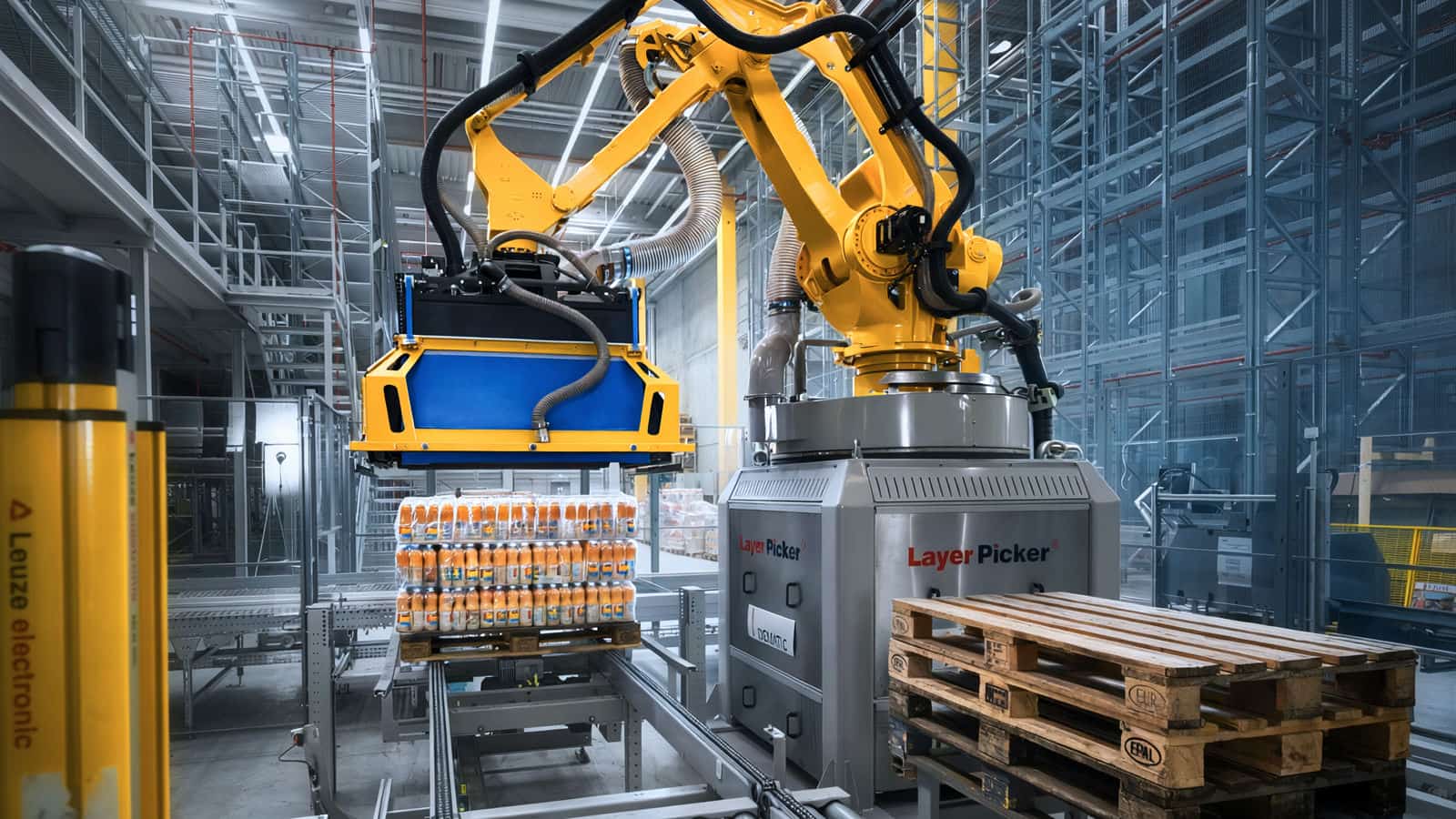
Automated palletizing robotics use advanced vision, gripping, and control technologies to build SKU-pure pallets or mixed-SKU/mixed-case pallets, while depalletizing robotics efficiently unload SKUs and cases for downstream processing.
Palletizing and depalletizing robotics improve consistency, increase throughput, and automate repetitive tasks. These robotics are especially valuable in fast-moving consumer goods (FMCG), food and beverage, and grocery operations. In cold chain operations, robotic palletizing significantly reduces the need for people to work in harsh conditions.
Key benefits of robotics in supply chain automation
Supply chain automation solutions that feature robotics come with several advantages:
Labor efficiency
Reduce the need for manual labor in repetitive or physically demanding tasks
Speed and throughput
Increase operational speed, especially during peak demand
Accuracy and consistency
Improve precision and reduce picking and packing errors
Scalability
Can be added or redeployed as business needs evolve
24/7 operation
Provide ability to run operations continuously for maximum return on investment
Safety
Minimize workplace injuries by moving workers to lower-risk activities
Flexible deployment
Allow automation to be implemented where and when it is needed
Seamless integration
Interconnect with new or existing warehouse management and control systems
System intelligence
Allow data-driven decisions for smarter, more efficient operations
BROCHURE
Robotic Order Fulfillment
Dematic Robotics is leading the way in making robotic automation functional, practical, and profitable for your production or distribution facility. Dematic solutions incorporate industrial robots, advanced vision technologies, intelligent motion planning, and product controls to meet your unique requirements.
Types of Dematic standard robotic solutions
Dematic robotic solutions offer multiple technology and software options to meet business needs for many types of operations. Key solutions include:
Dematic Robotic Piece-Picking Modules pick individual items of varying sizes and shapes into containers or bins. Typical applications range between 400–600 items per hour, with rates varying by configuration. Robotic piece picking provides reliable, around-the-clock automation for discrete item handling rather than full-case picking.
Industries best suited for robotic pick picking
Understanding robotic solutions
| Category | Description | Operational Impact | ROI Impact |
|---|---|---|---|
| Upfront Costs | Capital investment depends on the scope and scale of automation — ranging from targeted deployments to operation-wide deployments . | Influences rollout timing and project scope. Phased approaches can minimize operational disruption. | ROI improves as automation scales and efficiencies multiplies over time. |
| Integration Complexity | Requires close coordination with warehouse system software (WMS/WES) and existing operational processes. | Temporary workflow adjustments during implementation. Cross-functional alignment is critical for a smooth transition. | ROI depends on system interoperability and how effectively automation enhances throughput and accuracy. |
| Operational Adaptation | Introducing robotics often requires updates to workflows, operator training, and maintenance practices. | Drives process optimization and workforce enablement. Ensures consistent performance post-deployment. | Accelerates ROI when teams are trained to use system capabilities fully. |
| Technical Maintenance and Lifecycle Services |
Involves ongoing monitoring, preventive maintenance, spare parts, and software updates to sustain system performance. | Directly affects uptime reliability and productivity. Proactive service reduces unplanned downtime. | Affects total cost of ownership. Strong lifecycle support helps preserve ROI over time. |
| Complexity and Cost of Advanced Robotics |
More sophisticated automation requires deeper integration, precise engineering, and higher initial investment. | Longer deployment cycles and greater technical oversight. Potential for advanced functionality and scalability. | Higher upfront costs balanced by long-term ROI through productivity gains, labor optimization, and process resiliency. |
Robotics and Dematic Flexible Automation
Why choose Dematic as your automation partner
Built for continuous improvement
Our partnership continues long after go‑live. Dematic Lifecycle Solutions & Services refine, modernize, and expand systems as your business evolves. Assessment, optimization, training, and upgrades extend equipment life, improve performance, and reduce waste. Ongoing support featuring modular technologies and adaptable software allow you to grow your operations without disruption, securing long‑term value.