
Autonomous Mobile Robots (AMRs): Flexible automation for scalable order fulfillment and product transport
As e-commerce growth accelerates, so do expectations for faster, more accurate delivery. The challenge? Scaling operations for future growth within existing facility layouts while optimizing labor resources. To meet this challenge, companies must look to intelligent automated solutions like AMRs to provide the flexible and scalable technology necessary to grow their operations.
AMRs are industrial robots that lift and transport materials within your facility without relying on fixed infrastructure. They reliably navigate throughout the workspace by reading QR codes on the facility floor, responding to changing traffic conditions and adapting accordingly. Light Detection and Ranging (LiDAR) scanners mounted on the AMRs allow them to sense and avoid obstructions.
Typical applications and uses of AMRs
AMRs provide flexible automation for a wide range of applications across various industries that can be implemented based on customer needs. Dematic features two types of AMR solutions:
Goods-to-Person Fulfillment
AMRs transport inventory to and from workstations to support good-to-person picking operations, reducing picker travel and accelerating order cycle times. These AMRs carry either bins or shelves.
Point-to-Point Transport
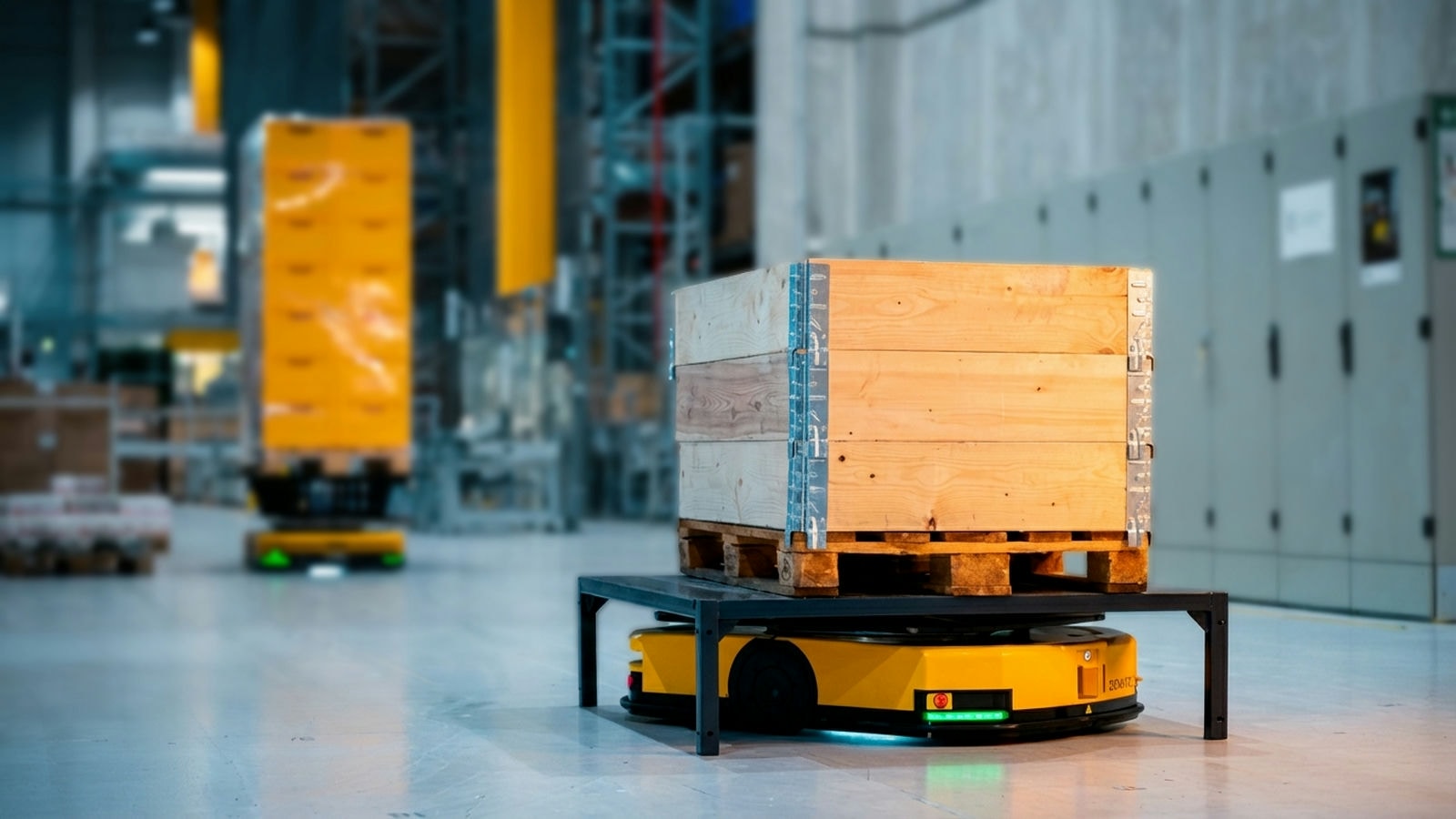
AMRs transport materials between different areas within warehouses or distribution centers, improving efficiency and reducing labor costs. These AMRs transport materials in totes or on pallets.
Key benefits of AMRs in supply chain automation
Supply chain automation solutions that feature AMRs come with several advantages:
Increased flexibility
AMR solutions scale up or scale down operations as needed to accommodate changes, growth, or processes. They do not require fixed routes, so they adjust quickly to new layouts.
Improved order fulfillment cycle times
Real-time optimization of labor and automation ensures faster, more efficient workflows so operations can adjust quickly to changing demands.
Built-in safety
LiDAR technology on each AMR detects and avoids obstructions. AMRs are certified to meet health, safety, and environmental standards to share workspaces safely with people.
Software-defined agility
Software provides real-time route optimization, workload balancing, and faster decision-making.
Labor resource versatility
AMRs perform repetitive tasks so limited labor resources can be applied to value-added tasks.
Faster go-live/faster ROI
Implementing an AMR solution is minimally disruptive to an operation, requiring less time and effort than traditional automated solutions. Operating and maintaining AMR solutions costs less to operate and maintain than using manual fork trucks.
Types of Dematic AMRs
Goods-to-Person AMRs
Goods-to-Person AMRs automate the retrieval and transport of goods directly to workstations where workers can quickly pick items as part of order fulfillment. This contrasts with traditional systems where workers travel to pick items from shelves or storage locations.
What are Bin-to-Picker AMRs?
Bin-to-Picker AMRs automatically lift and transport product SKUs in totes to and from workstations. They are a key part of a flexible and cost-effective goods-to-person process that efficiently handles order fulfillment operations and can scale quickly to meet rapid changes in business needs and customer demand.
Key features and benefits of Bin-to-Picker AMR solutions
- Reduced Order Fulfillment Cycle Times: Real-time data supports an on-demand approach that continuously balances workflows for the most efficient mix of labor and automation.
- Increased Operational Efficiencies: Adapts to changing operational needs to support highly efficient order fulfillment, maximizing use of resources and providing clear visibility into operations.
- Improved Customer Satisfaction: Accelerates order processing and quickly adapts to changing priorities to provide the speed and flexibility necessary to meet consumer expectations for order delivery.
- Optimized Vertical Space Usage: Vertical reach up to 12 meters allows facilities with limited floorspace to extend racking space upward and increase storage capacity.
Applications and use cases of Bin-to-Picker AMR solutions
- Decanting: When inventory is received into a facility, Bin-to-Picker AMRs automatically moves totes from decanting workstations to storage.
- Storage and Retrieval: When inventory needs to be stored or retrieved, Bin-to-Picker AMRs equipped with masts automatically place totes into storage racking or take them from storage racking.
- Picking/Outbound: When inventory needs to be brought to picking workstations, Bin-to-Picker AMRs bring totes to the workstations so workers can pick the required number of SKUs into outbound packages.
Types of Dematic AMRs
AMR Transport
AMR Transport moves materials within environments such as warehouses, manufacturing facilities, and distribution centers. Unlike traditional material handling solutions, these AMRs do not rely on fixed paths or predefined routes. Instead, they use advanced navigation technology to operate autonomously and navigate around obstacles in real time.
What is AMR Tote Transport?
AMR Tote Transport automatically moves totes, containers, or bins within various operational environments, such as warehouses, distribution centers, and manufacturing facilities. They autonomously navigate predefined paths or adapt to changing environments, helping streamline the movement of goods, materials, and inventories.
Key features and benefits of AMR Tote Transport solutions
- Increased Operational Efficiency: Significantly improve the speed and productivity of material handling operations, increasing overall throughput by operating without breaks.
- Enhanced Accuracy: Minimize manual touchpoints to reduce the likelihood of human errors in material handling and order fulfillment, which results in improved inventory accuracy.
- Improved Workplace Safety: Handle heavy lifting and repetitive tasks, which can reduce the physical strain on workers and instances of workplace injuries. Obstacle detection and collision avoidance provide safe operation around people and equipment.
Applications and use cases of AMR Tote Transport solutions
- Inbound Logistics: AMR Tote Transport moves incoming totes from receiving docks to storage locations, reducing manual handling and improving the speed of inventory management.
- Sorting and Staging: In distribution centers, AMR Tote Transport moves totes from one area to another based on sorting requirements, ensuring that items are organized efficiently for shipping.
- Work-in-Progress (WIP) Management: In manufacturing facilities, AMR Tote Transport moves WIP totes between various stages of production, helping maintain an organized workflow and eliminating bottlenecks.
Compare AMR solutions
| Bin-to-Picker AMR | Shelf-to-Picker AMR | Pallet-to-Picker AMR | AMR Transport | |
|---|---|---|---|---|
| Facility Fit/Infrastructure Requirements | Compatible with most warehouse layouts using bins or totes Integrates easily with existing infrastructure |
Flexible solution that adapts to a variety of facility layouts without major modifications | Works within existing pallet workflows Integrates smoothly with standard warehouse configurations |
Fits broadly in warehouses needing flexible transport paths Minimal changes needed for integration |
| Optimal Use Case | High-throughput picking of small, fast-moving items in totes or bins | Medium-volume operations requiring access to full shelves or racks | High-volume picking from full pallets — ideal for bulky or heavy items | Efficient transport of pallets, cases, or goods between zones or processes without picking |
| Automation Level | Automated: AMRs deliver totes/bins to static pick workstations |
Semi-automated: AMRs deliver mobile shelving to workers |
Semi-automated: AMRs deliver pallets to pick zones, workers pick from pallet |
Automated: AMRs move goods independently between points without interaction with people |
| Order Volume | High: Frequent, small SKU orders |
Medium to high: Ideal for batch or wave picking |
High: Consistent movement of palletized SKUs |
Various: Scalable for continuous or batch transport needs |
| SKU Variety | High Well-suited for e-commerce or retail assortments |
Moderate to high Shelves can store many SKU types |
Moderate Typically one SKU per pallet, but supports pick-from-mixed pallet |
Not a direct factor Transports goods or pallets regardless of SKU |
| Worker Travel Time | Greatly reduced Goods come directly to picker |
Reduced Workers remain at workstations while shelves are brought to them |
Reduced Pallets delivered to workers to minimize travel to racking |
Eliminated Workers freed for higher-value activities |
| Storage Flexibility | High Supports dynamic storage with compact tote/bin arrangements |
High Mobile shelving is configurable and re-deployable |
Medium Requires pallet staging zones, with layout planning for AMR navigation |
High AMRs can navigate multiple paths and adjust routes as needed |
| Throughput Speed & Efficiency | Very high Continuous delivery of bins enables rapid picking cycles |
Moderate to high Depends on shelf size, robot traffic, and picker performance |
High Allows high throughput when matched to ergonomic picking setups and intelligent routing |
High Transport throughput optimizes material flow across warehouse zones |
EBook
The GTP Handbook: Evaluation of Goods-to-Person Solutions for Optimized Item Order Picking
Download to for insights into the best, most cost-effective choices for your operation.
AMRs and Dematic Flexible Automation
Why choose Dematic as your automation partner
Built for continuous improvement
Our partnership continues long after go‑live. Dematic Lifecycle Solutions & Services refine, modernize, and expand systems as your business evolves. Assessment, optimization, training, and upgrades extend equipment life, improve performance, and reduce waste. Ongoing support featuring modular technologies and adaptable software allow you to grow your operations without disruption, securing long‑term value.